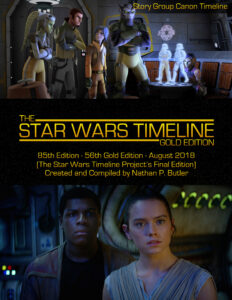
I turned 36 in 2015. Usually, a number like that isn’t a milestone, certainly nothing akin to turning 18, 21, 40, etc. However, for me it was quite a Finn (er, I mean, a “Big Deal”). You see, I had launched my Star Wars Timeline Project back at a time when I didn’t feel the need to actually track the starting date of my work. I know that I’d spent time toying around with it in 1996, but I didn’t put together a formal file or actually release it to others until later, nor put a date on any of the releases until The Star Wars Timeline 1.1, released on Jan. 13, 1998. That meant that I knew its first public release had been in 1997, just not the exact date during the final quarter of that year. As such, I decided that when discussing things like anniversaries for the project, I’d simply link the anniversary to my birthday (Oct. 17).
As a side effect of this, turning 36 became an important milestone, as it represented the day when I’d officially been producing The Star Wars Timeline (by then The Star Wars Timeline Gold or “SWT-G”) for literally half of my life: 18 out of 36 years. Any time spent working on it thereafter would mean that I had worked on it for more than half of my life, growing into a larger percentage with each passing year. By the time it ended with its last release on Aug. 11, 2018, I was about to turn 39 and had been working on the project for about 21 years. I’d spent slightly over two full decades producing a massive Star Wars fan project, something that, while it and my first podcast, ChronoRadio (2002 – 2007), did inadvertently lead to my ongoing “side gig” as a writer, had (and could) never directly provide any type of profit.
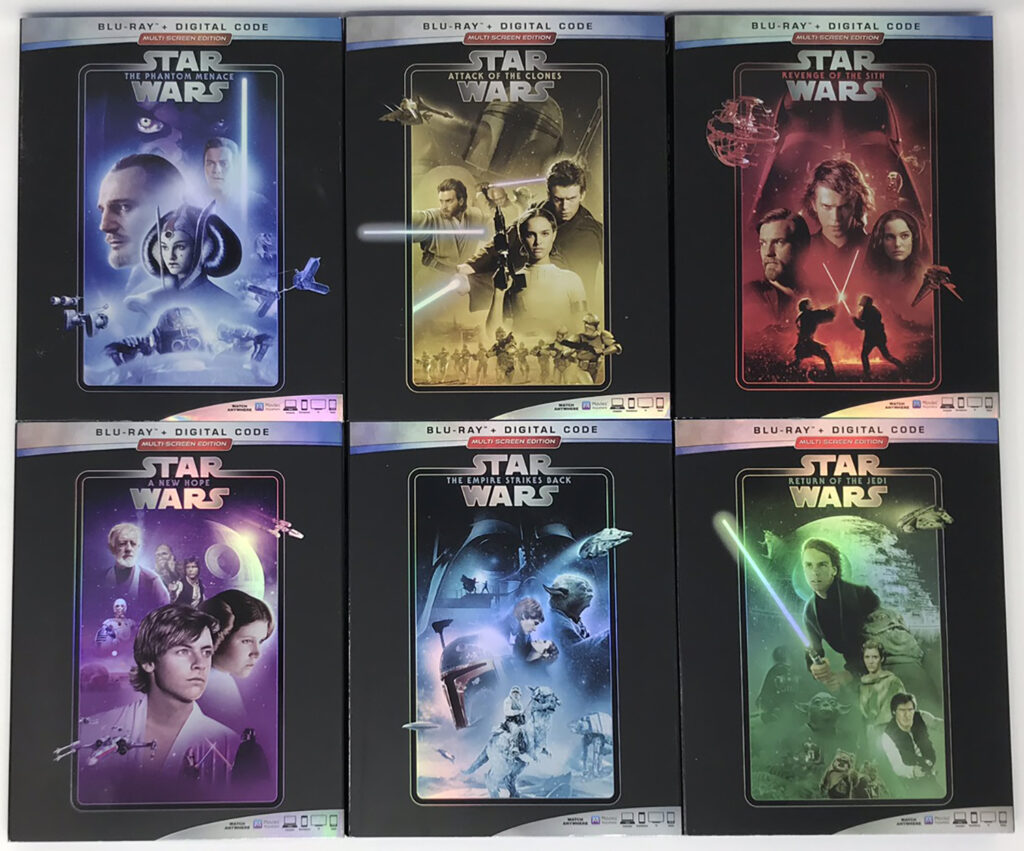
About a year prior to the end of the SWT-G, I’d also self-published a nearly 300 page guide to Star Wars home video releases from the United States, the first edition of A Saga on Home Video. Both were extensive guides to one aspect of Star Wars or another, based on something I collected. It raised the obvious question: Why create a guide of any kind? Why produce something like these projects, especially when the longest-running of the two could never earn a cent of income for all the work put into it?

I would love to say that either of these projects was mostly born out of a sense of duty to fellow fans. However, while that did play into why The Star Wars Timeline Gold continued for as long as it did, that wasn’t the primary impetus behind the project. Both projects were designed in part to fill a “gap” in fandom resources. A Saga on Home Video is the only resource of its kind (as a narrative history and guide, and even online resources that simply catalog home video products are few and far between). At the time it began, the Star Wars Timeline Project was one of only a few of its kind, and by the time it ended, there was no other Star Wars chronological project of its breadth and scope. (Its closest analog would’ve been something like Wookieepedia, but they are two very different beasts: one a chronology primarily developed by one person and the other an ecncyclopedia website developed by hundreds or even thousands of individuals.) So filling a niche and serving other fans were both part of the reason the projects existed, but not necessarily why they began.
Each of the works was a “passion project” or “labor of love,” growing from my own fandom, particularly for Star Wars home video collecting and the continuitiy of interconnected Star Wars stories now known as the “Legends” continuity. Even then, though, that explains the interest perhaps, but not the actual driving impulse to get started and keep going.
As it turns out, Henry Jones, Sr. (Sean Connery’s elder Jones in Indiana Jones and the Last Crusade), captured the rather mundane reason quite well. When his son, “Indiana” Jones, is shocked to discover that his father, whose passion for Holy Grail knowledge is extreme, doesn’t simply remember all of the salient details they need for their quest now that Henry’s “Grail diary” has been lost, he answers, rather testily, “I wrote them down in my diary so I wouldn’t have to remember!”
And that’s the key component to the creation of both The Star Wars Timeline Gold and A Saga on Home Video that is often missed. I love this stuff, but it’s not possible for anyone, even an expert, to recall every nuance of a particular subject, no matter how passionate they are about the topic. Both projects have, at their core, a desire on my part to create a guide for myself so that, despite my (presumed?) expertise in either area, I would not need to actually (and impossibly) remember all the minutiae of Star Wars chronology or home video release details.
It sounds self-serving, and in that aspect (if viewed in a vacuum), it certainly is. What I see as the thing that distinguishes someone creating projects like these and someone who attacks, tears down, and belittles others online with their in-depth topical knowledge of a particular corner of Star Wars information is not just a matter of tone. I happen to believe that someone with a deep understanding of a subject, if presented with the opportunity to help other fans learn about that subject or expand their understanding of the subject, should, if possible, be willing to share that information. It’s one of the things about fandom that can help engender goodwill and cooperation, especially in an era like the one we’re living in today, wherein social media exacerbates fandom’s divisions and rarely its unifying facets.
So, why create a guide of any kind? It’s a labor of love that channels your own passion for a subject (and requires that passion to be maintained in order to maintain work on the guide itself), but it is often created as an aid for one’s own reference. Some fans just feel a pull toward the Light Side (so to speak) and believe that such knowledge and experise is meant to be shared for the benefit of others when possible.
It was definitely all about me.
But then it was definitely all about you.
It was all about us: the unifying ties within fandom.
If someone creating a fandom guide can look back on years, or even decades, spent on such a project with that mindset, I think we can decide that all the time and effort was worth it.